
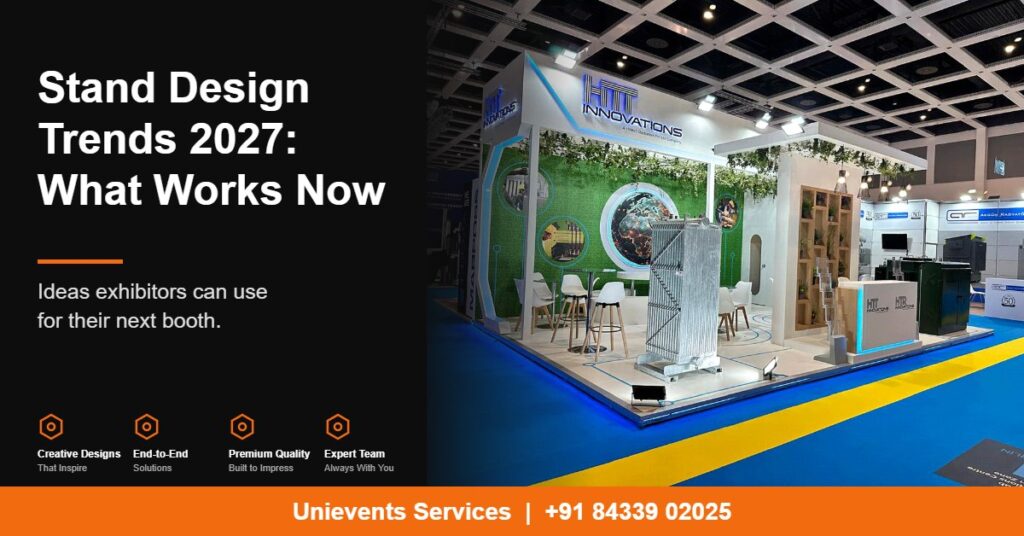
Every year the same question comes up before the design brief: what should a stand look like next season? Good exhibition design does not chase fashion. It borrows the ideas that help visitors find you, understand you and stay longer. Below are six directions we are seeing in stands being briefed for 2027 shows, how to use each one, and a few ideas to treat with caution.
The six trends in one line each
- One strong brand wall instead of many small messages
- Warm, layered lighting instead of flat brightness
- Open, welcoming layouts with fewer barriers
- Natural textures and greenery mixed with clean finishes
- Live product zones and short demos
- Reusable, modular builds with custom fronts
1. One strong brand wall
Visitors walk the aisle at a steady pace, and you have only a few seconds to be understood. Stands that do well usually carry a single clear message: the brand name, one line on what you do and one hero product or image. Crowded walls with six claims and ten logos blur together.
How to use it: write your message in one sentence, put it at eye level and above, and keep it readable from the far end of the aisle. If you are unsure how a wall will look from a distance, ask your designer for a 3D view from the aisle. See how we prepare 3D exhibition stand designs before fabrication.
2. Warm, layered lighting
Halls are lit for safety, not for display. Stands that look premium usually layer their own lighting: a bright, even wash on the main wall, focused spots on products and a softer warm glow in the meeting area. The change in mood tells visitors where to stop and where to sit.
How to use it: light the product first, the wall second and the floor last. Avoid putting spots where they shine into visitors’ eyes. For more detail, read our notes on layout and lighting for exhibition booths.
3. Open, welcoming layouts
Tall counters across the whole front and closed walls on open sides make a stand feel like a shop window you cannot enter. Stands with two or more open sides are moving toward lower counters, a clear entry point and seating that can be reached without crossing a barrier.
How to use it: keep the front of the stand open and clear, place the reception at the side and make the meeting area visible from the aisle. If you are still choosing a stand type, our guide to island, corner and inline booths explains what each open side gives you.
4. Natural textures with clean finishes
Wood-effect panels, fabric, plants and soft materials next to white or coloured laminates make a stand feel less like a temporary box. This works especially well for furniture, food, wellness and lifestyle brands, and it also softens a technical stand for visitors who spend a whole day on their feet.
How to use it: choose two or three materials and repeat them. Real plants need care and are sometimes restricted by venues, so ask your stand partner what is allowed and use quality artificial greenery where needed.
5. Live product zones and short demos
A product on a plinth is easy to ignore. A product that is being used, tested or explained draws a crowd. Many exhibitors are building a small demo corner with a screen, a working sample and a staff member whose only job is to run a five-minute demonstration.
How to use it: plan the demo space in the layout from the beginning, including power points, storage for samples and a place for visitors to stand without blocking the aisle.
6. Reusable builds with custom fronts
Exhibitors who attend several shows a year are asking for a stand that can be reused. A common approach is a modular or system structure with custom graphics and a custom front that changes with the show. It keeps the brand consistent and reduces how much is built again each time. We compare the options in custom vs modular exhibition stands.
How to use it: decide early which parts will repeat (structure, lighting rig, furniture) and which will change (graphics, product display, sizes). Check exhibition stand cost in India to see how size and finish affect the budget.
Ideas to treat with caution
- Too many screens. Moving images catch the eye, but several screens competing with each other make the stand noisy. One well-placed screen is usually enough.
- Complex shapes for their own sake. Curves and cut-outs look good in a render but add fabrication time and cost, and they may not fit the organiser’s height or structure rules.
- Heavy text. If a visitor cannot read your message in a few seconds, it will not be read at all.
- Designing without the exhibitor manual. Height limits, hanging sign rules and power loads differ by show. Always read the manual before the concept is final.
Choosing what fits your show
Not every trend suits every stand. A small stand of 9 to 18 sqm benefits most from a single brand wall, good lighting and an open front. A larger stand has room for a demo zone and a meeting area. Start from your goal, whether that is leads, launching a product or meeting existing buyers, and choose the two or three ideas that serve it. Check the exhibition calendar for the shows you are planning and brief the design early.
Planning a stand for a 2027 show? Share the show name, stand size and your main goal, and we will suggest a design direction and send a 3D concept and quote within 24 hours. Get Your Custom Stall Design →
Stand design trends 2027: quick answers
What are the main exhibition stand design trends for 2027?
Six directions stand out: one strong brand wall, warm layered lighting, open and welcoming layouts, natural textures with clean finishes, live product zones with short demos, and reusable modular builds with custom fronts.
Do I need to follow every trend?
No. Choose two or three that support your goal, such as lead generation or a product launch. A simple stand that is clear and well lit often works better than one that tries to use every idea.
Are modular stands a good choice for several shows?
Yes, if you attend more than one or two shows a year. A reusable structure with custom graphics and a custom front keeps the brand consistent and avoids building everything again for each show.
How early should I brief the design team for a 2027 show?
Eight to ten weeks before the show is a safe starting point for a custom stand. Large or complex stands and shows abroad need more time, so brief as soon as the space is confirmed.
Can a small stand look premium?
Yes. A single clear message, good lighting, a clean layout and two or three well-chosen materials can make even a 9 sqm stand look premium.