
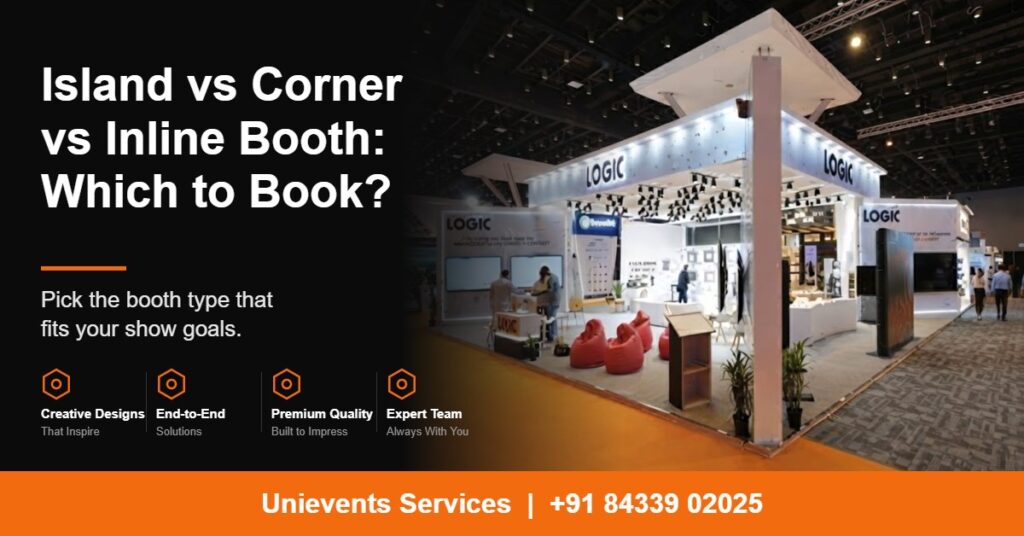
The organiser has sent you the floor plan and asked which position you want. Inline, corner, peninsula or island: the choice looks like a line on a drawing, but it decides how many aisles your visitors arrive from, how much of the stand they can see and how much the stand costs to build. Here is how to choose without guessing.
The 30-second answer. Tight budget or a product that needs a quiet demo: inline. Want more visibility without island-level cost: corner. Need a back wall for storage but want three faces on show: peninsula. Large space, product launch, meetings and several demo zones: island.
The four booth types side by side
| Type | Open sides | Where it sits | Best for | Watch out for |
|---|---|---|---|---|
| Inline (row) | 1 | Between two neighbours in a row | Focused product shows, tighter budgets, first-time exhibitors | One face to the aisle; visitors only notice you when they are right in front |
| Corner | 2 | At the end of a row, with a neighbour on one side | More visibility from two aisles at a moderate step up in cost | Decide which aisle is the busier one and face your main wall to it |
| Peninsula | 3 | End of a block, back wall shared with the stand behind | Big brand presence with a solid back wall for graphics and storage | The shared back wall is not yours to use freely; check height rules |
| Island | 4 | Free-standing, with aisles on every side | Larger stands, launches, meeting areas, several demo zones | No hidden back: all four sides must look finished, and rules on height and hanging structures are stricter |
Inline booth: when one strong face is enough
An inline stand is the most common and usually the most affordable position. You share side walls with neighbours, so the stand is effectively a wide, shallow room with one opening. That is fine when visitors are coming to find you, for example at a specialist show where buyers walk the rows with a shortlist.
The design challenge is standing out from the stands on either side. Put your strongest message at eye level on the back wall, use lighting to make the stand look brighter than the aisle, and keep the front open so visitors can step in. If you are still weighing a ready-made shell against a built stand for an inline space, our comparison of shell scheme vs custom stand covers where each makes sense.
Corner booth: two faces for a moderate step up
A corner position gives you two open sides, which means visitors see you from two directions and approach from two aisles. For many exhibitors this is the best value position on the floor: you get most of the visibility benefit of an island without having to finish four sides.
Look closely at the floor plan before booking. If one of the two aisles is a main thoroughfare and the other a quiet side aisle, put your branding and reception on the busy side and use the quiet side for seating or a demo. Avoid leaving the return wall blank; a plain wall facing an aisle reads as unused space.
Peninsula booth: three faces and a solid back
A peninsula sits at the end of a block, open on three sides, with a wall shared with the stand behind it. It is popular with exhibitors who want a strong, visible brand presence but also need a back wall for storage, a graphic or a screen. Exhibitor manuals often limit the height of structures near neighbouring stands, so confirm what you can build on the shared side.
Island booth: the full 360 degrees
An island is surrounded by aisles on all four sides. It is the most visible position and the most flexible: you can run a reception, a product demo area, a meeting room and a storage core in one structure. It is also the position where design matters most, because every side faces visitors. There is no back wall to hide cables, boxes or staff bags, so storage has to be built into a central core.
Islands often allow taller structures and hanging signs that can be seen across the hall, but only where the organiser permits them. Rigging, hanging structures and double-deck designs usually need drawings approved in advance, so share your ideas with the organiser early.
Match the booth type to your goal
- Collect as many leads as possible: a corner or island works best because visitors can approach from more directions and the queue does not block the aisle.
- Demonstrate a machine or product in detail: an inline or corner stand with a defined demo area is enough, as long as the demo does not block the opening.
- Launch a new brand or product: an island, so the launch can be seen from every direction and from a distance.
- Hold private meetings with buyers: peninsula or island, where a closed meeting room can be built without losing display space.
- First show on a limited budget: inline, with a well-designed back wall and good lighting. A strong small stand beats a weak large one.
How the booth type changes the design
Booth type changes the build as well as the position. With more open sides, there are more surfaces to finish, more lighting to plan and more routes for visitors to walk through. The floor area matters at least as much as the type: a 36 sqm inline stand and a 36 sqm island have the same floor but very different design needs. For help choosing a size first, see our booth size guide, and for a budget view see exhibition stand cost in India.
Many organisers also charge a premium for corner and island space on top of the standard rate per square metre. The exact surcharge is in the exhibitor manual or booking form, so ask before you compare quotes.
Five questions to ask the organiser before you book
- Which sides of the space are open, and which one faces the main aisle?
- What is the maximum height for walls and for hanging structures?
- Are hanging signs and rigging allowed, and who installs them?
- Are there limits on walls facing neighbouring stands?
- Is there a surcharge for corner, peninsula or island space, and how is it calculated?
Once you have the answers, send us the floor plan. Our 3D stand design team can show you the same stand as inline, corner and island options so you can compare before you decide.
Not sure which position suits your show? Share the show name, the floor plan and your stand size, and we will suggest the layout and send a custom design with a quote within 24 hours. Get Your Custom Stall Design →
Booth types: quick answers
What is the difference between a corner booth and an island booth?
A corner booth is open on two sides and shares walls with neighbours on the other two. An island booth is open on all four sides, with aisles all around it, so every side faces visitors.
Is a corner booth better than an inline booth?
A corner booth gets visitors from two aisles instead of one, so it is usually more visible. It also costs more, so it is worth it when visibility and walk-in traffic matter more than keeping to a tight budget.
What is a peninsula booth?
A peninsula booth sits at the end of a block and is open on three sides, with its back wall shared with the stand behind it.
Do island booths cost more to build?
Usually yes. An island has four open sides to finish, more lighting and often taller structures, and the organiser may charge a premium for the space. The size of the stand matters as much as the type.
Can I hang a sign or banner over my booth?
Only where the organiser allows it. Hanging signs and rigging are usually permitted on island or large stands and need approved drawings, so check the exhibitor manual before design starts.
Which booth type is best for a first-time exhibitor?
An inline or corner booth with a well-designed back wall and good lighting is usually the best value for a first show. You can move to a larger or island position once you know the show works for you.