
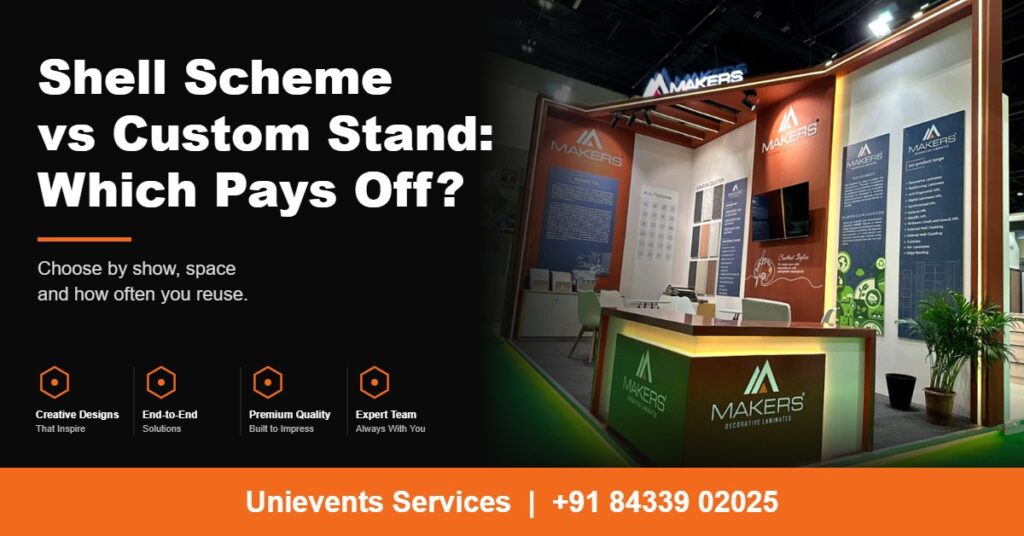
You have booked 18 sqm at a trade show. The organiser’s manual offers two ways to fill it: take the shell scheme that comes with the space, or hire a builder for a custom stand. The shell scheme looks cheaper on the invoice. The custom stand looks better in the render. Which one actually brings you more business?
The honest answer is that it depends on three things: what the show is, who walks the aisle, and how many times you will reuse what you build. This guide gives you a clear way to decide, with no sales push either way.
What a shell scheme really is
A shell scheme is a basic stand package that many organisers offer with the space. You get a set of walls (usually white panels on an aluminium frame), a fascia board with your company name, carpet or flooring, a few spotlights, a power point, and sometimes a table and two chairs. Everyone in the row gets the same frame. What you do inside it is up to you.
Because the structure is standard, the organiser has already planned the fire safety, the electrics and the build time. That is the real value of a shell scheme: it removes risk and paperwork.
What a custom stand really is
A custom stand is designed around your brand, your products and your floor space, then fabricated and installed by a builder. You choose the layout, the height, the lighting, the graphics, the storage and the way visitors move through the space. The builder also handles drawings approval, freight, installation and dismantling.
Shell scheme vs custom stand: side-by-side
| Factor | Shell scheme | Custom stand |
|---|---|---|
| Upfront cost | Lower. Often bundled in the space rate. | Higher. Design, fabrication, freight and labour are added. |
| Brand impact | Limited to your fascia, graphics and what you place inside. | Full control over shape, colour, lighting and messaging. |
| Time to plan | Days. Order graphics and furniture. | Several weeks for design, approval and fabrication. |
| Risk of rejection | Very low. The structure is pre-approved. | Needs drawings and approvals, which a good builder handles. |
| Layout flexibility | Fixed modules. Hard to open up or add a meeting zone. | Any layout that fits the space and the show rules. |
| Reuse at other shows | Not reusable. It belongs to the organiser. | A modular custom stand can be reused and reconfigured. |
| Best for | First tests, small spaces, low-budget shows. | Flagship shows, product launches, shows with many competitors. |
When a shell scheme is the smarter choice
- You are testing a new show. If you have never exhibited there, spend on the space and your sales team first. Upgrade the stand next year if the leads justify it.
- Your space is 9 sqm or smaller. In a small space, a clean shell with strong graphics and good lighting can look as sharp as a custom build.
- The show is a one-off. If you will not return, a stand you cannot reuse is hard to justify.
- Your product is the star. Machines, vehicles or large samples draw the visitor. The stand only has to stay out of the way.
When a custom stand pays for itself
- You are in a crowded hall. At shows where hundreds of exhibitors sell the same thing, a distinct stand is what makes a buyer turn into your aisle.
- You need to run meetings. A shell has no private corner. A custom layout can include a closed meeting room, a demo area and a reception counter.
- You exhibit every year. A modular stand reused at three or four shows spreads the cost. Read our guide on custom vs modular exhibition stands to see how reuse works.
- You are launching something. A launch deserves a stand that tells the story, with a screen wall, product plinths and lighting you control.
The middle path: dress up a shell scheme
You do not have to choose one extreme. Many exhibitors keep the shell scheme and upgrade it with three things that cost a fraction of a full build:
- Large-format graphics that cover the walls from floor to ceiling, so the white panels disappear.
- Your own lighting. Add track lights or LED strips to replace the standard spotlights.
- Furniture and a counter in your brand colours instead of the rental default.
Check the exhibitor manual first. Some organisers restrict what you may stick to the walls, and the rule changes from show to show.
Four questions to settle it
- How many competitors will be within 50 metres of me? The more there are, the more a distinct stand matters.
- Will I take meetings on the stand? If yes, you need seating and some privacy.
- Will I use the stand again within 12 months? If yes, think modular custom.
- What is my cost per lead target? Divide the total stand spend by the leads you expect. If the custom build raises the lead count enough to lower that number, it is the better buy.
Rule of thumb: spend on the stand in proportion to what one new customer is worth to you. If one customer pays back the whole stand, a custom build is easy to justify.
A quick example
Imagine a food-ingredient exporter at an 18 sqm space. In a shell scheme, the stand has two white walls, a fascia and one table. The exporter adds a printed backdrop, a branded counter and a small sample display. The stand looks tidy and the sales team can talk to buyers, but there is no space to sit more than two visitors.
In a custom build, the same 18 sqm holds a sample wall, a four-seat meeting table behind a low partition, a storage cupboard under the counter and a screen that loops product videos. The buyers stay longer, and follow-up meetings happen on the stand instead of in the corridor. Whether that is worth the extra spend depends on the average order value, which only you know.
What to ask your builder before choosing
- Can the custom design be reused and reduced for a smaller space at the next show?
- Who gets the drawings approved by the organiser, and how long does it take?
- What is included in the quote: freight, installation, dismantling, power, carpet and furniture?
- Can you show a photo of a stand you built at a similar-sized space?
If you are comparing quotes, our guide to how to compare exhibition booth builder quotes lists what to check. For pricing ranges, see exhibition stand cost in India. For reference on how exhibitions are measured and benchmarked worldwide, the UFI global association of the exhibition industry publishes industry research.
Not sure which suits your next show? Send us the show name and your space size, and we will tell you honestly whether a shell upgrade or a custom build makes sense. Get a Free Design + Quote →
Shell scheme vs custom stand: quick answers
What is a shell scheme stand?
A shell scheme is a standard stand package provided by the organiser. It usually includes panel walls, a name fascia, flooring, a few spotlights and a power point.
Is a shell scheme cheaper than a custom stand?
Yes, in most cases. The shell scheme is bundled with the space or priced as a fixed package, while a custom stand adds design, fabrication, freight and installation costs.
Can I decorate a shell scheme stand?
Usually yes. You can add graphics, lighting, furniture and a counter, but you must follow the organiser’s rules on what may be fixed to the panels.
Does a custom stand bring more leads?
A custom stand does not guarantee more leads, but it helps you stand out, gives you meeting space and keeps visitors longer, which improves the chance of a good conversation.
Which is better for a first-time exhibitor?
A shell scheme with good graphics is a sensible starting point at an unfamiliar show. Move to a custom stand once you know the show delivers buyers.
Can Unievents help if I only need to upgrade a shell scheme?
Yes. We design graphics, lighting and furniture upgrades for shell schemes, and we also build full custom stands.